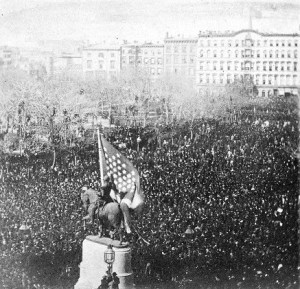
Senator Edward Baker of Oregon, who will soon die in the battle of Balls Bluff, makes a speech and concludes his remarks by saying:
Upon the wings of the lightning it goes out throughout the world that New York, by one hundred thousand of her people, declares to the country and to the world that she will sustain the government to the last dollar in her treasury, to the last drop of your blood. The national banners waving from ten thousand windows in your city to-day proclaim your affection and reverence for the Union.
During the course of the war, the U. S. Sanitary Commission, an official agency of the United States government comprised of women volunteers who want to contribute to the war effort, take the flag on a tour around the North. It is used as a fund-raising tool, and is “auctioned” off to the highest bidder, who turns the flag and the money back over to the commission so it can be auctioned again.
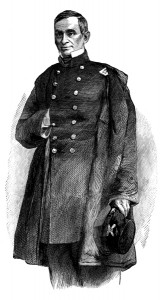
On September 15, 1863, Secretary of War Edwin M. Stanton requests a report from Major Anderson on the disposition of the Fort Sumter flag. Major Anderson writes the following:
On my return to Washington, I mentioned to President Lincoln and Secretary of War Cameron the fact of my having brought the Flag from Fort Sumter, and that it was securely boxed and stored in New York, and that I had never allowed it to be unboxed. I feel that no one can guard the sacred relic as I do, and it is my earnest desire that when Fort Sumter shall–by God’s blessing–be again our own I may be permitted by the government to then once more unfurl it; or should I die before that time, that it may be wrapped around my body when it is borne to its last resting place.
Apparently, Anderson’s wish is granted, and he continues to be the flag’s guardian. But how could the Sumter flag travel the North and also be safely in the Major’s care? Well, it appears that there were at least two Fort Sumter flags.
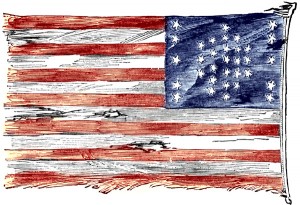
On April 11, 1863, on the third anniversary of the initial attack on Fort Sumter, a mass meeting is again held in Union Square in New York. In a document containing the text of a collection of speeches delivered on that day, is a speech by Reverend J. T. Duryea. At the conclusion of his address,o Duryea relates the following story to the crowd:
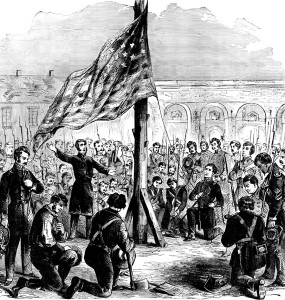
One word more. Let me tell you an incident. In Fort Sumter, two years ago, before the bombardment, General Anderson brought out the old flag that had been raised upon that flagstaff, and tied the halliard to the flag, and gathered his men around him, and asked the chaplain to kneel by the flagstaff and pray. He knelt with closed eyes, one hand above grasping the halliard, the other below, and thus kneeling there at the foot of the flagstaff, before God, the chaplain prayed that that flag might never be lowered in the face of the enemy.
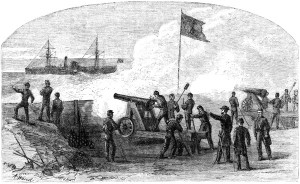
After Fort Sumter had yielded, and the flag had been lowered, General Anderson called the man who had charge of the pennant halliard, and asked him if the flag had been lowered by himself. Said he,”The old flag that we raised upon the flagstaff when we were bowed in prayer around it, was torn by the gale, and the day before the bombardment it was taken down to be mended; and when the call came to rehoist the flag, we took a new one because the other was not sewed together. We hoisted the new flag instead of the old one; and the old flag, baptized with prayer, and consecrated with uplifted hands to God, and besought of God to be kept from desecration, never was lowered in the face of the enemy.”
General Anderson told me that flag never was hoisted before the enemy, nor before the enemy was it ever lowered. “I have it in New York,” said Major Anderson, “and I am patiently awaiting the time when I can bend on the halliards again, and not amid prayer, but amid song and thanksgiving, again hoist the old ensign to the peak.”
I told him,”That flag shall rise again.”
My fellow-citizens, if you love the destiny of mankind; if you love the oppressed and downtrodden of the earth; if you love your country; if you love your family; if you love your children, say, will you swear here before God, that flag shall rise there again? Will you that love the past; you whose hearts are full in the present, you before whom hope shines brightly in the future, lift up now your good right hands to heaven and say, that flag shall rise there again? Then let it rise, ‘and long may it wave, O’er the land of the free and the home of the brave.’
On March 22, 1865, Secretary Stanton, by order of President Lincoln, issues General Order No. 5o. The end of the war is near, and Union troops occupy the city of Charleston. Order No. 50, one of the last orders Abraham Lincoln will ever sign, states:
That at noon, on the 14th of April next, Major-General Anderson will raise and plant upon the ruins at Fort Sumter, in Charleston Harbor, the same United States Flag that floated over the battlement of that fort during the rebels’ assault, and lowered and saluted by him and the small force under his command when the works were evacuated April 14, 1861.
So on the 14th of April, 1865, on the fourth anniversary of the evacuation of Fort Sumter, Brevet Major-General Anderson, by order of President Lincoln, raises that identical flag once more over the ruins of Fort Sumter.
Five thousand soldiers, sailors, and citizens assemble in the battered and shapeless fortress. A prayer is given by Reverend Matthias Harris, the same chaplain who had delivered the prayers at the raising of the flag on Fort Sumter in December, 1860.
Sergeant Hart, who had replaced the flag after it had been shot away in the bombardment of the fort, quietly pulls the old flag out of a Fort Sumter mail bag. It is attached to the halyards by three sailors who were in the first fight. Then Major Anderson steps forward and says:
I am here, my friends, my fellow-citizens and fellow-soldiers, to perform an act of duty to my country dear to my heart, and which all of you will appreciate and feel. Had I observed the wishes of my heart it should have been done in silence; but in accordance with the request of the Honorable Secretary of War, I make a few remarks, as by his order, after four long, long years of war, I restore to its proper place this dear flag, which floated here during peace before the first act of this cruel rebellion.
I thank God that I have lived to see this day, and to be here, to perform this, perhaps the last act of my life, of duty to my country. My heart is filled with gratitude to that God who has so blessed us, who has given us blessings beyond measure. May all the nations bless and praise the name of the Lord, and all the world proclaim, ‘Glory to God in the highest, and on earth peace, good-will toward men.’
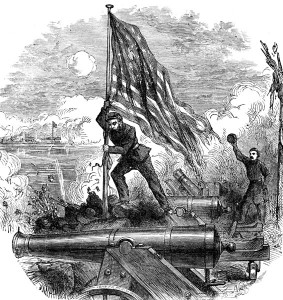
Anderson then pulls the halyards and sends the tattered banner up the staff. A one-hundred gun salute is given followed by a national salute from every fort and battery that fired upon Fort Sumter in Charleston Harbor.
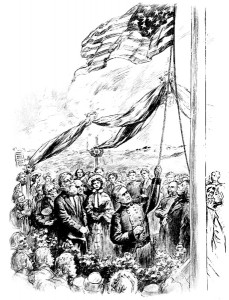
Reverend Henry Ward Beecher gives a lengthy oration in which he says of the flag:
On this solemn and joyful day, we again lift to the breeze our fathers’ flag, now, again, the banner of the United States, with the fervent prayer that God would crown it with honor, protect it from treason, and send it down to our children, with all the blessings of civilization, liberty and religion. Terrible in battle, may it be beneficent in peace.
When Anderson dies in 1872, the flag is wrapped around his casket as it travels from New York to West Point for burial.
In New York on the thirty-fourth anniversary of the evacuation, April 14, 1895, Mrs. Anderson, who had the flag in safe-keeping, brings it out for display at a gathering of soldiers and sailors who had served in the area of Fort Sumter during the war. Of this event, Dr. Henry Clay Trumbull, army chaplain, writes:
Every officer and man present had battled and endured in the trenches of the sea islands, or had done service in the vessels of the navy before Charleston Harbor or off Fort Sumter. General Stewart L. Woodford, afterwards our Minister to Spain, presided. That identical flag, which had been lowered by General Anderson in 1861, and raised by him again in 1865, and which had not afterwards been seen in public since it was wrapped about his coffin in 1871, was once more exhibited, by the favor of Mrs. Anderson, who had it in keeping. It was stretched across the platform behind the patriotic speakers. Its rents from shot and shell were more eloquent than Caesar’s gaping wounds, telling their story by their “poor dumb mouths.” It was accompanied to that gathering, at the special request of Mrs. Anderson, by members of the old Anderson’s Zouaves as a body guard of honor. As one and another of the officers who spoke pointed to that old flag, and reminded us all of what it had stood for, and of what it had cost, in those four years of war, to restore it to its rightful supremacy, the scene was dramatic and impressive. All realized the worth of that flag, and the value of the efforts to restore its supremacy.
When Mrs. Anderson passes away in 1905, the flag is presented to the United States War Department, as stipulated in Mrs. Anderson’s will.
For a time, the flag is displayed in the office of the Secretary of War in Washington, enclosed in a mahogany case, carefully folded and tied with bands so as to show as much of the flag and as little of the bullet holes as possible.
The Fort Sumter Flag can currently be seen in the museum at the Fort Sumter National Monument, an enduring symbol of the trials that so many faced during the American Civil War.
Sources:
Harrison, Peleg D. The Stars and Stripes and other American Flags. Boston: Little, Brown, and Company, 1914.
Leepson, Marc. Flag: An American Biography. New York: Thomas Dunne Books, 2005.
Moore, Frank, ed. Fort Sumter Memorial. New York: Edwin C. Hill, 1915.
Preble, George Henry. History of the Flag of the United States of America. Boston: A. Williams and Company, 1880.
The Royal National League. Opinions of Loyalists Concerning the Great Questions of the Times New York: C. S. Westcott & Company, 1863.
Smith, Colonel Nicholas. Our Nation’s Flag in History and Incident. Milwaukee: The Young Churchman Company, 1903.
Smith, Percy F. Memory’s Milestones: Reminiscences of Seventy Years of a Busy Life in Pittsburg. Pittsburg: Murdoch-Kerr Press, 1918.

 Be sure to visit